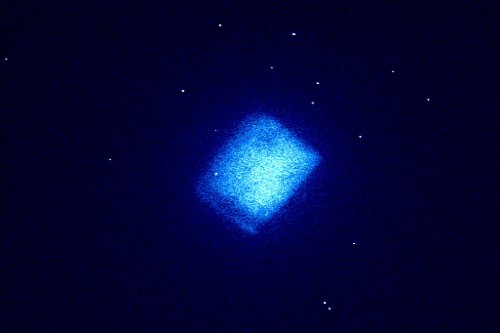
Weak radio luminescence captured by a low light intensity camera from a synthetic diamond carbon film made from beta-emitting carbon-14 atoms. (Image: University of Bristol)
The world’s first carbon-14 diamond battery became a reality in a United Kingdom laboratory this past December when it was created by scientists from University of Bristol and the U.K. Atomic Energy Authority.
Inside the New Safe Confinement covering the sarcophagus of Chernobyl’s Unit 4. (Photo: SSE Chornobyl NPP)
A team of scientists from the United Kingdom’s University of Bristol were given access to the Chernobyl nuclear power plant in Ukraine, advancing a project to train robots and artificial intelligence systems to measure radiation and create 3D maps.
A slideshow of the team’s visit to Chernobyl’s Unit 4 control room and New Safe Confinement structure, where they deployed radiation mapping and scanning sensors, including a LIDAR-equipped robot call Rooster, appears on Gizmodo.